Friday, July 16, 2021

1884

MOORE'S ALMANAC - GULGONG
A goldfield about 20 miles from Mudgee.
  • Magistrates— Philip Snape, P.M.; G. Rouse, R. Rouse, jun., R. Rouse, sen., S. A. Blackman, J. F. Plunkett, S. T. Bishop, and J. C. Souter, M.D.
  • Clerk of Petty Sessions— C. Coghlan Warden— P. Snape
  • Officer in Charge of Police and Gold Receiver— Senior-Sergeant M. Burns
  • Mining Registrar — H. De Boos
  • Storekeepers— Marks, Young, Russell, Barrett, Brown and Co.
  • Principal Hotels — Orlovich’s Sportsman’s Arms, John Powell’s, Angoves Hotel, Mrs. Mary Powell’s, Tattersall’s, White’s Star Hotel, Moverley’s Albion, Kelly’s Family Hotel
  • Newspaper— “People’s Advocate
  • Banks —New South Wales, A. J. Stock
Source: Moore's Australian almanac and hand-book for the year ... (1884)

Gulgong and its Mines.

Illustrations

1. Lowered Down the Shaft, White Horse Claim. 2. Stores of M. Marks and Co. 3. General View of Gulgong. 4. Waiting to Descend. 5. Store of W. Thompson, 6. Rouse's Paddock Mine. 7. At End of Drive—Men at Work.

THIS town, the centre of a large mining district well known for the great quantities of gold obtained, is situated almost at the northern end of the main range forming the watershed between Cooyal Creek on the east, and the Cudgegong River on the west. It is about 18 miles from Mudgee; communication between the places being maintained by Cobb's coaches, which run daily. Soon after leaving Mudgee, the traveller sees evidences of the extent of mining industry which has and is still being carried on; old shafts and deserted workings being visible along the greater part of the road, on which the only township met with is Home-Rule, where signs of past life and activity are visible in the shape of several dilapidated stores and hotels, left to the mercy of the wind and rain.

General View of Gulgong.
The tall white building in the middle is the Bank of NSW.

Soon after leaving there Gulgong comes in sight, in the centre of which is noticeable the fine white building erected by the Bank of New South Wales towering high above the other structures, and by far the finest building in the town, the greater part of the houses being built of wood. On entering, an old whim on the summit of a hill, on the border of the town, is observable. Here it was that gold was first discovered in this part of the colony; and from this point the ground was worked in all directions. The principal thoroughfare in the town is Mayne-street. It is narrow and winding, and from its formation a visitor can readily perceive how the earlier buildings must have been erected close to each side of the rough bullock track at the time of the first gold rush. During the prosperity of the diggings it is estimated that fully 20,000 people lived in and around the town. Within the past few years, in consequence of many of the claims being abandoned, the number has greatly decreased; but now that the mining interests in the district are reviving, it is more than probable that the next few years may witness a considerable influx of population.

The Church of England, St. Luke's, a fine stone structure which has been erected about nine years, is situated on the crest of a hill which commands a good view of the neighbourhood. The present incumbent is the Rev. J. S. Dobson. The Roman Catholic Church, which is at the foot of the hill, has been built some 10 years ago, and is of wood; the services being conducted by visiting members of the clergy from Mudgee. The Congregational Church, also a wooden edifice is presided over by Mr. Beard. There is likewise a Presbyterian Church.

Gulgong also possesses a theatre—the Prince of Wales, which was built at the time of the rush. The Post-office is a neat building, and the lock-up and police barracks are well arranged. There are also several hotels, and three or four good-sized stores.

Among the business establishments may be mentioned that of Messrs. M. Marks and Co., in Mayne-street. This is one of the principal general stores in Gulgong, having extensive premises and possessing a separate establishment for the sale of boots and shoes. In the large store a great variety of general merchandise is kept in stock to meet the demands of their large circle of patrons. A portion of the main store is divided off into a millinery and a men's clothing department, which are kept in full swing. Another leading establishment is that of Mr. W. Thompson, Times Bakery and Produce Store, which is the only store in the town built of stone and is situated at the corner of Herbert and Bayly streets. The business has been established since 1871; and, without doubt, Mr. Thompson has the largest stock of general produce in the district, also a fine assortment of confectionery. At the late Sydney International Exhibition Mr W. Thompson was awarded a prize medal for bread, the same at the time of judging being seven days old.

The present Mayor of Gulgong is Mr. John Tuxford, a resident of some 18 years' standing. The Municipal Council have, to all appearance, exerted themselves to improve the town by having the roads aligned, kerbed, and guttered, the quartz metalling proving excellent for the streets, the total mileage of which, in the municipality, being 50 miles made, and 18 unmade. The amount of rateable property is £85,000; the population of the town and seven miles around being about 2000, and the estimated area of the municipality being about 33 square miles.

With reference to the revival of the mining industry in the district, it should be mentioned that a great deal of this is due to Mr. Orlovich, an old Gulgong miner, who some time back secured the lease of Mr. Rouse's Paddock, also that of the Black Lead and the Britannia claims, and unsuccessfully endeavoured to float a company in Sydney to work them. In Melbourne, however, some 12 months back, he met with much better fortune. Messrs. Brigham and Marshal, of that city, took up the whole affair in a most enterprising manner, formed companies, and are at the present time the largest mine owners in Australia. They secured most of the claims, and have at present the following mines on the Gulgong goldfield:—Rouse's Paddock, Rouse's Paddock Extended, Rouse's Paddock Consols, The Black Lead, Moonlight, Britannia, White Horse, and Forty-four. At present only a portion of the claims are being worked, but when operations are in full swing, it is estimated that 800 men will be actively employed.

Rouse's Paddock Mine

Rouse's Paddock is the largest claim now open on the field, and extends one mile in length by half a mile in width. It is about two miles from the town. On the surface eight different leads were worked until they dipped into ground containing so much water and hard basaltic rock that the aid of powerful machinery to work the same became indispensable. Our illustrations include a view of the claim, together with a sketch representing our artists attired and ready for exploring the workings, together with another representing the end of the drive, with the miners at work on the face. A large amount of gold has been obtained from the various leads, one side of which is of granite formation, the other being a slate formation, having in the middle what is called "ticia" drift, on the top of which is the wash carrying payable gold; in fact the workings in the deep ground are all on a false bottom, the real main bottom not having yet been reached. In the drift, diamonds have been found, and the manager, Mr. Thompson, intends shortly to wash some 40 loads to test its quality in this respect more fully than has hitherto been done. With regard to the working of the mine a fine plant of machinery is now in full swing, and is well worth inspection. The main shaft is down to a depth of 156 feet, and at present the lengths of the various drives is over 1000 feet.

1884 - [The Miner. An Old-New Goldfield.]
THE fame of Gulgong and the adjacent goldfields of Tallewang, Home Rule, Canadian, and Diamond mines, 12 years ago, was bruited all over the world.
 
In those days Herbert-street was fully two miles long, and was one of the noisiest and most bustling thoroughfares in Her Majesty's Australian dominions. No fewer than 62 hotels represented the regular trade in the groggery interest, while the irregular, unauthorized trade in this line baffles all calculation now, even as it baffled all scrutiny then.
 
Some 50 stores flourished then in the township. Three local newspapers were run, a daily, a bi-weekly, and a weekly. Fifteen blacksmiths pointed the picks for the diggers and carried on general business. Three newspaper agencies received and distributed the news of the world. Butchers, bakers, fruiterers, and even fishmongers had a wonderful time of it. Vendors of those suspicious liquids called "summer drinks" concocted delicious abominations at their own sweet will, and the thirsty diggers drank them down like milk. Appalling specimens of ignorance and effrontery haunted the township under the guise of medical practitioners. Loose morals and licentious living were the order of the day. The clergy were powerless to stem the tide, and the police barely contrived to maintain a semblance of outward order. Frightful traditions still survive in connection with the lower groggeries and dancing saloons. They were very hells upon earth. Here congregated the scum of the colony, both male and female, and here the lucky digger was plundered without mercy, and poisoned without redress. And yet, in spite of a large posse of police, both mounted and foot, in spite of the ferreting inquisitions of a resident detachment of the detective force, in spite of the notorious presence in the township of criminals of the first water, the amount of crime that was tracked home and punished was exceedingly small. Judged by the records of the police courts, Gulgong was a comparatively law-abiding place. 
At this time gold was being unearthed in bucketsful. So immense was the yield that lucky new chums imagined the precious metal would become almost valueless. Many an unscrupulous gold-buyer traded upon this illusion, and nuggets were weighed without much nicety on butcher's scales, 16oz to the lb.
The whole country around Gulgong bears testimony to this day to the rich alluvial yield of '71 and '72. Nor was reefing less productive. A few of the old reefs still survive, and are paying handsomely. The famous Red Hill claim was a very mountain of gold. Nos. 4, 5, 6, and 7 Happy Valley are reputed to have paid from £5000 to £8000 a share, while Nos. (3, 4, 5, 6, 7, 15, 16, 17, Black Lead gave to each shareholder from £4000 to £6000. One lucky speculator netted in a few months a sum of £40,000 the product of which only a few heavily mortgaged houses remain. When Gulgong was in full swing no fewer than 25 puddling machines were on the ground, three quartz crushers, with a brigade of 200 carters with their horses in constant work. In those days 12oz of gold from a load of washdirt was a common yield, as much as 100oz to the dish was occasionally realized. The suburban goldfields also showed miraculous finds. Many large fortunes were made at Canadian, Home Rule, Nil Desperandum, Rouse's Paddook, Three-mile, Two-mile Flat, Diamond Mines, and Tallewang.

At the present time, after years of depression, mining matters are decidedly looking up at Gulgong! Melbourne speculators are in the field, and companies have been floated which are carrying on operations in Rouse's paddocks and the old Caledonian Lead. The famous Black Lead is also being tried once again. Nos. 44 and 26 are reported to have engines at work, and no less than 100 acres have been pegged off in this spot for fresh sinkings. On the Britannia, Home Rule, an engine has also been erected. Only recently the old Christmas lead paid the handsome dividend of £400 per shareholder. At the White Horse claim, Canadian, from £8 to £10 per week per man is regularly netted. A Mudgee company (Wilton and Chappell, managers) have taken up the old Canadian Prospecting claim, and placed a powerful engine upon it. At the commencement of the new year it is confidently expected that hundreds (some say thousands) of miners will be in the pay of the various new companies, and it is quite within the limits of the probable that large tracts of old and abandoned territory may be thoroughly re-tested.

As an agricultural area, the country around Gulgong could hardly be surpassed. In the rich alluvial flats, from 30 to 40 bushels of wheat to the acre commonly accrue, and much valuable farming land is still open to selection. A large section of the Gulgong common could be advantageously commuted into market gardens and small farms. An inexhaustible supply of water for domestic purposes is stored in what is locally known as the "WaitAwhile;" but as the favours of Jupiter Pluvius are both frequent and abundant in this rangy region, a sufficient quantity of aqua pura is generally caught from the corrugated iron roofs to satisfy all ordinary demands.

The commercial condition of Gulgong is highly reassuring, and full of promise for the future. Trade, if not positively brisk, is steady and regular. The necessaries of life are, and always have been, wonderfully cheap, and Sydney prices rule in almost every department of business. At the general establishments of R. Brown and Co., M. Marks and Co., Messrs. Young and Co., and many others, very large stocks are kept, and the consuming public has every reason to be satisfied with the price and quality of the goods. The leading hotels are the Albion (Moverley's), Tattersalls (Mrs. Powell's), Orlovich's, Kelly's, Bennett's, and Powell No. 2. Local journalism is represented by the PEOPLE'S ADVOCATE.

Every species of handicraft is carried on in Gulgong. Blacksmiths, wheelwrights, coachbuilders, saddle and harness makers, tailors, and shoemakers are in plenty. Thompson's bakery is a fine stone building in the centre of Herbert-street, and is quite a repertoire of general produce. The public buildings of the town are a credit to the district. The local hospital is commodious, healthily-situated, and kept in admirable order and cleanliness by the present wardsman, Mr. Holden. The institution is generously supported by residents in the neighbourhood. The police court, sergeant's quarters, and barracks are new buildings of light and elegant design, but strong and massive enough in the prisoners' compartments. The post and telegraph offices are also quite new, and show the latest appliances, with ample accommodation. The warden's office, over which Mr. Snape, P.M., presides, savours of the old days, but appears to answer every practical purpose. 

The public school is a large antiquated weatherboard structure, making no claim to architectural beauty, but sufficiently commodious withal, and pitched in a salubrious, and sequestered spot. Mr. Cosgrove is the newly-appointed head-teacher. The Bank of New South Wales, now in course of erection, is at once the loftiest, handsomest and most costly edifice in Gulgong, and dwarfs all the adjacent buildings. Mr. Voss is the manager. The Joint Stock is managed by Mr, Ramsay, the respected son of an old identity of the district. Gulgong possesses a most picturesque cemetery, in every part of which flowers bloom in wild unkempt luxuriance. We wonder much that the town council does not appoint a curator over this neglected spot, but possibly the municipal authorities have no jurisdiction here. On the local cricket ground, a grand stand has been recently erected, but the sward within the enclosure is utterly uncared for, and the really fine local team has to play matches on the town common. A public park, a racecourse, and a well-selected library are also amongst the attractions of Gulgong, the last especially reflecting great credit on the intellectual bias and moral discrimination of the people. 

Three churches survive in the township, Roman Catholic (to which is attached a well patronised school), Church of England, of which the Rev. J. S. Dobson is incumbent, and Congregational, of which the eloquent and esteemed James Trevor has been for many years the respected pastor. We understand that Mr. Trevor is on the point of resigning the Gulgong church, having received a warm invitation from the Mosman's Bay Congregational Church in Sydney. It only remains to be stated that Gulgong is a municipality represented by 8 aldermen and mavor in the person of Mr. Zimmler.
[Written by] RAMBLER.

Thursday, July 15, 2021

TUXFORD

TUXFORD'S DAM

Tuxford's dam
Anglican rectory in background.
Source:  Peter Martin


[PERSONAL RECOLLECTIONS]

Tuxfords Dam was originally a watering hole for stagecoach horses. At the rear of our house in Mayne street, (which backed onto the dam) there used to be stables where the horses were housed overnight.
Source:  Peter Martin


As a child I, along with all other eligible Phegan siblings, attended All Hallows’ school. In those days the playground for the girls was the school ground and the boys' was across the lane...

At the bottom of the boys' playground and at the rear of the houses facing Mayne street was a huge dam known as Tuxford's Dam. That extended right to almost the rear of Max Cross's Neptune Service Station [sic, Golden Fleece]. I have no idea whether it was to supplement the town supply or as the bowling club end was vacant maybe it was part of a TSR (someone will know).

This dam at the base of its wall had a George and Annis Bills water trough. Tuxford's Dam was drained about 1960 and I clearly remember myself and Stephen Thurling walking out through the mud as the dam dried up collecting hapless turtles caught in the same. What we did with them I have no idea. The area of which I speak was later built out with government housing and these still exist.
Source: Warwick Phegan


1878 - [EARLY MENTION]
On 8 July, 1878 Thomas Farlow reported a missing/stolen brown draught horse. His address was given as "Tuxford's Dam, near Gulgong."
Source: New South Wales Police Gazette and Weekly Record of Crime (Sydney : 1860 - 1930) Wed 24 Jul 1878 [Issue No.30] Page 265

1888 - GULGONG, Friday.
Hares are plentiful and destructive here. The farmers are compelled to put palings around their orchards and gardens. A shooting party went yesterday to Samuel Blackman's, at Cooyal, and shot 145 in a few hours. Tuxford's Dam, the sole dependence of carriers and stock around the town, is now dry.
The weather is fine and warm. Wheat is rising, the present rate being 4s. 6d.

Location of Tuxford's Dam, 1887 Parish map

Aerial Photo of Gulgong. Tuxford's Dam on far left.
Source: Gulgong Pioneers Museum


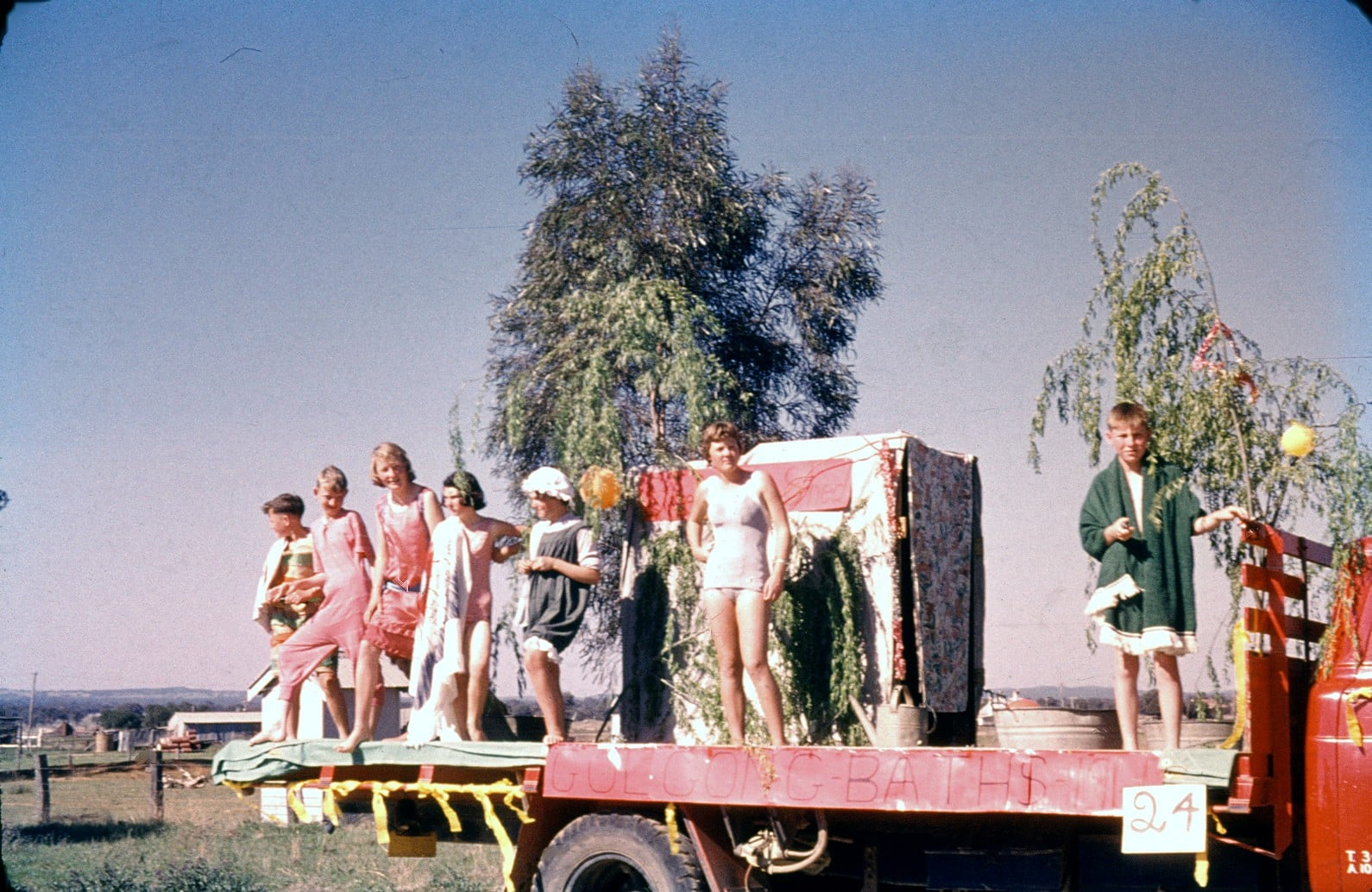
POOL PARADE 1962


The "Black Maria"
Mike Campbell and Bruce Campbell in the front, with Hunter Watt, Barry Seis and Philip Bard in the back.

\
Black Maria - "police" vehicle.
Source: Ailsa Campbell


1962_______________________________________

Pool Parade 1962: Jan Ellis, Veronica Hill, Gai McKechnie, possibly Kay Jackson.

Pool Parade 1962
Source: Robin Croome

Fay Lane, Sapphire Princess in the Pool Parade, 1962

Pool Parade, 1962

1962 Pool Parade, Sheila Alexander (Croake)

1962 Pool Parade, Fay Lane

1962 Pool Parade, Jean Kelly, Diamond Queen
Also Zella Martin, Shirley Wilson, Marilyn Gorrie, Lyn Davis
1962 Pool Parade, Jean Kelly as Queen


1962 Pool Parade

1962 Pool Parade

1962 Pool Parade

1962 Pool Parade

School float
Source: Ailsa Campbell

Rob McKechnie
Source: Ailsa Campbell

Fire brigade
Source: Ailsa Campbell

Parade vehicles
Source: Ailsa Campbell

Ulan County Council float
Source: Ailsa Campbell

Decorated Ute
Source: Ailsa Campbell

Fisheries float
Source: Ailsa Campbell

Princess float
Source: Ailsa Campbell

Jean Kelly, Diamond Queen
Also Zella Martin, Shirley Wilson, Marilyn Gorrie, Lyn Davis
Source: Ailsa Campbell

Gold Fever float
Source: Ailsa Campbell


BACK TO GULGONG WEEKEND, 1959

The "Black Maria", 1959 parade.
Source: Peter Martin

Caption: SULKY RIDE for Miss Nell English, Barry Hollow, and dog Lassie during "Back To Gulgong Weekend" procession.
Source: The Australian Women's Weekly (1933 - 1982) Wed 11 Feb 1959 Page 13


In Gulgong, A town relives its golden past
By HELEN FRIZELL, staff reporter

• Gold nuggets glittered in shop windows, bearded gentry and their ladies danced in the streets, and the town of Gulgong, N.S.W., last week became a movie director's dream as its 20th century characters celebrated the 19th-century goldrush.

FEW oldtimers could recall the 1870s, when Gulgong—with 20,000 inhabitants—was termed the "Hub of the World," but some remembered how red flags over diggings proclaimed new gold strikes, and Cobb and Co's scarlet-and-gold coaches brought new arrivals to town.

A TUNE on the squeeze-box is played by Mr. Arthur Adams, of Gulgong. During the procession Gulgong residents reenacted scenes from the past. Floats carried old windlasses and rawhide buckets. Others showed recent progress.

Up and down narrow, twisting Mayne Street crawled modern cars bringing visitors to GuIgong's ''second gold rush." "If you haven't got a nugget, a pound note will do." read placards on miners' gold-dishes which were passed round to collect money for Gulgong's great project the Memorial Swimming Baths [sic]. The "modern" money piled in, but people who owned nuggets made no secret of the fact that they considered them too precious to give away. One man who could pull a nugget from his coat pocket was 76-year-old Mr. Val Taylor, son of an original gold miner.

"Look at this town." said Mr. Taylor, pointing to barn dancers who, just before midnight, were whirling over the bitumen of Mayne Street. "The crowds. This is what it used to be like. People everywhere, It's wonderful. "Of course, the town looks different. When I was a boy, the houses down the street were made of stringy box bark, and miners still lived in tents out on the paddocks.
"There were hotels everywhere, a ballroom, and a roller-skating rink. And round the corner Cobb and Co.'s stables, which were pulled down only a few years back. "I was a blacksmith, and used to shoe their horses, as well as putting steel in miners' picks and sharpening them up.
"You should have seen those Cobb and Co. coaches. They looked lovely, painted in red and yellow colors that never faded."

January 1959 "Back to Gulgong Weekend"

BUSHRANGERS creep up from the rear as the Bank of N.S.W. float makes its way down Mayne Street. Gulgong. On float is a set of scales that weighed gold mined in Gulgong during the 1870s. Bank manager Mr. G. Single was president of the committee which organised celebrations to raise funds for a Memorial Swimming Pool.

At the Country Women's Association display of historic photograph of Gulgong, I met Mr. Harry Gudgeon, who could remember many of the old scenes. "What was it like in the old days? I'll tell you what you'd have seen," said the former blacksmith. "Grass growing in the streets. An army of goats walking along; little bark houses and shops; a bark theatre. On a wet day you'd have watched "speckers" looking for gold in the streets. "They often found it, too." said Mr. Gudgeon. "The streets were covered with dirt taken from 'tailings' of the mines. "And the miners were all bearded, you know. You weren't a man if you hadn't a beard. "When the miners came into town they wore red or light flannel shirts, white moleskins with bowyangs, and corks around their hats. Their boots were beautifully polished."
 
The longest memory in Gulgong belongs to Mrs. Blanche Wood, now 93, who was a girl when the goldrush began. "Everyone was making towards the Gulgong diggings," said Mrs. Wood. "They had bullock waggons and big tilted drays. They brought horses and goats. Not much furniture, though, for they travelled light. "The streets were so crowded with miners you could hardly move. And the miners crowded the hotels. The place was strewn with corks, too. Beer bottles were corked then, not capped. And the children used to run around collecting the corks and getting paid for them afterwards. Miners stood round talking and gossiping. At night, the main street was lit by square lamps, with candles in the middle. When it got dark, you'd see thousands of little fires out at the diggings. Henry Lawson was here. I knew him," said Mrs. Wood. "Red flags flew when gold was struck. Then the gold used to leave the bank under escort for Sydney. We children used to run out to watch them go. We loved seeing the red-coated escort riding with his rifle on his knee."
 
The first gold at Gulgong was discovered by Mr. Tom Saunders in 1870 and two years later 134,455 ounces of gold was mined. An interested visitor to the "Back to Gulgong" weekend was Mrs. W. Saunders, of Randwick, who is a daughter-in-law of the discoverer. Today there's no gold mining in Gulgong, though many people are convinced gold is still there for the taking. Now the town—197 miles from Sydney, with a population of 2137—is the centre of an agricultural and grazing area. Grass has covered the yellow mullock heaps, and miners' descendants graze sheep and cattle in quiet paddocks once riddled with shafts and tunnels.
 
Mr. Dal Hollow farms land at Canadian Lead, where his grandfather James was among the miners of the 'seventies. Just across the road is the Canadian Lead Post Office. It was once one of 26 hotels lining the two miles of road from there to Home Rule. Gulgong's present-day hotels were packed during the 1959 celebrations, when visitors bought 1000 copies of "Written in Gold - The Story of Gulgong."
 
Colorful story
This book was edited and written by Mrs. Keith Maxwell, of "Sansgrove," Gulgong. The mother of four young children, Mrs. Maxwell spent months poring over historic records and photographs and interviewing dozens of people, and she worked till after midnight compiling her book.
 
During celebrations, president of the "Back to Gulgong Weekend" committee Mr. G. Single and secretary Mr. Frank Halloran helped organise a dance, giant procession, sporting events, billycart and wheelbarrow derbies, art shows, photographic displays, and tours of the gold areas. All proceeds went towards building the Memorial Swimming Baths. At present. Gulgong people can only cool off in the shallows of Reedy Creek, which had to be specially dammed for swimming sports.
 
They look forward to better swimming in the future but looked back to the past during the weekend, when the Sydney Bush Music Club played squeezeboxes on street corners and led choruses in singing of "Click Go the Shears" and Australian bush ballads. Mr. "Duke" Tritton, who fossicked for gold in Gulgong 50 years ago, came back as a member of the Sydney Bush Music Club, and brought with him a ballad he'd composed specially for Gulgong. The last stanzas read:

"At night I'll hear the rattle And clank of the windlass holes.
As the formless ghosts of the digger hosts Come out of their golden holes
To tell the world they've "struck it'' And hoist the flag that told.
The crimson rag, that bright red flag, The sign of the men on gold.
"Gone is Gulgong's golden glory. And Gulgong's golden ways.
But the mullock heaps where the warm wind sweeps Tell of the olden, golden days."


ABOVE: Historic photograph taken by Beaufoy Merlin in Gulgong in 1872 comes from the Holtermann Collection, Mitchell Library. It shows miners, a police officer, and publican on corner of Herbert and Mayne Streets waiting for Cobb and Co's coach to leave.

BELOW: Present-day [1959] shot by staff photographer Ron Berg was taken at same spot early one Sunday morning. In costume are Mr. and Mrs. Athol Meers, of Gulgong, Mr. and Mrs. Bob Rayner, and Mr. and Mrs. Laurie Wright, all from nearby Mebul.

________________________________________________

Bullock train, part of the 1959 procession
Source: Barbara Gurney

EMPIRE DAY

Empire Day, Victoria Park Gulgong, year TBC
Source: Provided by Barbara Gurney

Empire Day, 1905

Empire Day, 1913
Post Office Hotel on the left. Photo taken from corner of Herbert and Mayne
Source: John Esber

1909 - EMPIRE DAY AT GULGONG

Empire Day was celebrated at Gulgong with every show of patriotic enthusiasm. A good programme of songs was submitted at the public school, and addresses were delivered by the Mayor (Ald. A. E. Brigden). Mr. F. S. Stacy and Rev. F. A. Malcolm. In the afternoon sports were held in Victoria Park and an address was delivered by Councillor E. J. Lowe, President of the Wyaldra Shire. The following are the results of the sports: —
  • All Schools Championship, 100yds., for boys; prize, gold medal. — E. Foley (Wyaldra) 1; won by a yard.
  • All Schools Championship, 50yds., for girls ; prize, gold medal. — Susie Woods (Beryl) 1; won after a dead heat with N. Campbell, by three inches.
  • All Schools Championship, high jump, prize, silver medal. — E. Foley (Wyaldra) 1; 4ft. 1 in.
  • All Schools Championship long jump, prize, silver medal. — A. Buckley (Wyaldra) 1; 14ft, 9in.
  • Empire Bicycle Handicap, 2 miles. — H. Saddler 1, W. Riley 2, Lindner 3 , won by about a yard.
  • Sheffield Handicap, 120 yards. — Jack Huxley (ser.) 1, G. Huxley (7yds.) 2, McEvoy (11yds.) 3; time, 13 1/4 sec.
  • Handicap for boys over 14 years, 100 yards. — A. Buckley 1, Guy Lambert 2.
  • Handicap for girls, 12 to 14 years. — Olive Murkins 1, H. Grimshaw 2.
  • Handicap for boys, 12 to 14 years.—V Tuxford 1, C. Pettiford 2.
  • Handicap for girls over 14 years. — Nellie Campbell 1, Neine Wild 2.
  • Extra race for girls.— A. Thomas.
  • Tug of war, for boys (six from each school) —Wyaldra 1, Gulgong 2.
  • Relay Race (four from each school) — Gulgong Public School (F. Russell, S. Miller, L. Manusu, J. Rognini) 1, Wyaldra Public School 2; won amidst great excitement, by a yard.
  • Girls' Race, 10 to 12 years.— D. Davis.
  • Skipping Race.— N. Campbell.
  • Sack Race.— K. Greenhalgh 1, Brophy 2.
  • Bicycle Handicap, for boys, 3 laps. — E. Miller 1, W. Stott 2, Hill 3. Won easily.
  • Log Chopping. Contest, logs 3ft. long, 14 inches through, red gum timber; first prize £2, second 15/. —H. Gunson (30 sec.) 1, R. Day (40 sec.) 2, J. Cooper (40sec.) 3. Won easily; time 65 seconds.

ARGUS 1874 - MARCH

_______________________________

GULGONG EVENING ARGUS - 26 March 1874
_______________________________

Editorial about Agriculture in NSW [not reproduced].

The Escort left this morning with 2382 ounces 2dwts, 10 grains of gold and 257 pound notes.

Fatal Accident -this morning a fine lad about 18 years of age, the son of George Inder for many years in the employ of Mr. Rouse of Biraganbil was riding a horse in the home paddock, for some reason the horse bucked threw its rider breaking his neck and killing him on the spot.

Local Industry yesterday we had the pleasure of visiting the extensive coach factory of Mr. Matthews in Queen Street. A large number of men and lads are kept constantly employed. 

One tray buggy constructed by Job Edwards, is a fine substantial piece of work-manship, light, strong, with the floor at a convenient height from the ground and elegantly and tastefully painted and cushioned. With the exception of the springs all the work was done on the premises.

We have a few factories already and hope to see more. It is stated on good authority that water from a high level could be brought from large never failing springs beyond Home Rule, if such engin-eering work could be accom-plished. Nothing could would more tend to establish the town of Gulgong on a permanent and satisfactory basis than the erection of a first class mill, especially if it had a saw mill attached to it. Mr. Jackson with his tannery and Samper and Jackson with their soap works all add to the town’s future.


Mining Report [unreadable, not reproduced]

COURT NEWS

Work and Labour Done
White v Leggatt, work was prospecting at the claim David Buchanan. Man named Turner, Mr. McNamara, gave evidence, verdict for plaintiff.

Small debts

  • Dr. Ramsay v Simmons
  • Daley v Conway
  • Dr. Ramsay v Greening and wife

Lefrand v Newton—evidence by Miss Allsop sister of Lefrand, Mrs. Annie Campbell

Pettit v Buckhan—neighbours—Matilda Pettit accused of stealing cloths off the line. Emily Pettit, sister, gave evid-ence, as did Mrs. Woolladge, verdict for the defendant.

Bibb v McGrath overpayment of orders. C. Driscoll, Mr. Green of Green’s Hotel and Mrs. Bibb all gave evidence. Verdict for defendant.

Wanted.
Good Female Cook for the WELLINGROVE HOTEL, Glazier’s Paddock, wages 15/- per week. Apply to Mrs. Green, Green’s Hotel.

Wanted
To buy a Light Cart Harness. Apply CHARLES WIGGINS, all Nations Hotel.

E. Davis,
Timber Yard, Herbert Street.

Canadian School
A Concert and Entertainment Funds devoted to the Purchase of a Harmonium

For Sale
William Thompson selling all his machinery, guns, Dynamite at Black Lead.

_______________________________

Committee for Public School Fete—B. Stacy, C. Young, C. Bird, H. Farr, J. Bowes, A.W. Honour, Wm. Craigen, P. O’Neill, J. Scully, S. Samper, J. Powell, T. A. Browne, J. Hunter, Geo. Stott, R. Collins, Jno. Hill, E. Thomas, J. Trounce, J. Sellman, W. Selff, W. Wesley, W. Thomson, H. Rossiter, C. Giugni, W. A. Byrne, E. Finch, C. B. Cairnes, R. Jones, J. H. Cogden, A. J. Allum, 


Wm. Binder, T. B. Scurrah, J. McDonald, C. Baker, C. Driscoll. S. Green, H. J. Woods, L. S. Donaldson, G. D. Lang, T. Nightingale, J. Deitz, N. Langdon, S. S. Moses, J. H. Heydon, C. Cassell, T. Mills, A. McCulloch, G. E. Shettle, R. Graham, H. K. White, W. B. Hunter, J. McLachlan.

JAMES PLUNKETT, Hon. Sec.

_______________________________

 GULGONG EVENING ARGUS - 28 March 1874
_______________________________
Editorial 
[about Buchanan and O’Con-nor, not reproduced]

Divine Service 

Church of England:
Gulgong and Guntawang by Rev. W. S. Newton, M.A.

Lowe’s Paddock by Mr. W. G. Clark

Presbyterian: Rev. T. J. Curtis

Congregational Church: 
Gulgong, Rev. J. Trevor,
- Home Rule, Mr. R. Williams, - Canadian, Mr. Smith.

Gulgong Hospital We remind the Treasurer of the hospital that there is now lying in the Treasury, Sydney, the sum of twenty-six pounds, twelve shillings and nine pence, which can be obtained by him for the hospital, being the unclaimed balance from the Talbragar and Coolah Pounds paid into the treasury from 1st January to 31st December, 1871.

Prospecting—J. G. O’Connor places a resolution on the paper for a vote of five thousand pounds for the prospecting purposes; but the Government having agreed to place two thousand pounds on the estimates for a like purpose. 

Mr. O’Connor has withdrawn his motion, as it was prudent for him to do so, considering that half-a-leaf was better than no bread. Mr. O’Connor thinks that this grant may be made an annual vote.


More Rain - The rain which set in on Monday last with slight periodical showers and a constant drizzle did not cease till Wednesday afternoon. It rained pretty heavily the whole of Tuesday and Tuesday night, and the streets and ground which had been well moistened by previous rains, did not really absorb the additional water in the wet and puddle caused by the rain. The Cudgegong River rose a few feet and the quantity of water that fell in and around the town was considerable up to Wednesday. Thursday was fine, although the weather seemed by no means settled.

To Let - A FARM of 50 acres close to the Shallow Reef, a running creek bounding the farm. Apply to Mrs. MARG-ARET ROBINSON, near Shallow Rush, Home Rule.

Gulgong Public Hospital—Tenders for the supply of WOOD, WATER and MILK, for six months
RAMSAY -Secretary 

Reward for lost horse John M. Davey Canadian Bakery

Notice In consideration of the Rise in the Price of Flour, we, the undersigned, give notice that on Monday, 30th March the PRICE of BREAD will be FIVE PENCE [5d] per 2 lb loaf.

John M. Davey
William Thompson
Frank Walton
J.H. Taylor
O’Neill Bros.

_______________________________
 
GULGONG EVENING ARGUS - 31 March 1874
_______________________________

Editorial [not relevant to Gulgong, not reproduced]

Mr. Browne, P.M. has been called away this morning to hold an inquest at Cobbora, into the death of Thomas Hodgen, who was thrown from a spring cart, the mining cases set down for hearing today were postponed till next Thursday.

Prospecting—this morning, German Charley and party commenced sinking a prospecting shaft about one mile from town in a westerly direction, and not very far from Mr. Rouse’s lagoon on what was formerly called the Great Western Lead. Several shafts were sunk there about a year ago and bottomed at 120 or so feet, but no gold was found. The present party have commenced nearer the range and as many miners have fancied the locality, as giving every indication of being auriferous, a good lead may be opened.

Dangerous customer—on Monday Mr. Johnson and his mate were on their way to their prospecting shaft, near the lagoons, on the Tallewang Road, they saw a snake coiled in a tuff of grass. They attacked the reptile which showed fight, biting the stick and grinding it between the jaws in the fiercest manner. After killing, they examined it and found that it was 3 feet 6 inches long, large in the middle and tapering more than is the case usually with snakes toward the extremities. It was a lead on colour on the back and vermillion on the belly. From the description and savage manner, we conclude this to have been a most venomous kind of character.

The Municipality We trust that there will be a thorough investigation into the matter of petition for a municipality at the Court House tomorrow before the P.M. There is no doubt it will be for the ultimate benefit of the inhabitants to have Gulgong formed into a municipality.


Jumping Claims the Commissioner investigated a jumping claim yesterday. It appears the shareholders in No. 24 Black Lead had their claim registered a few weeks ago and suspended work. About 12 months ago they succeeded in getting out a quantity of wash from their westerly shaft, which would have been payable except for the water they had to contend with. They needed machinery to work the wet ground and registered for the purpose of procuring the requisite mach-inery. The jumpers thought the work should proceed with and that registration was effected upon false promises. From the evidence the Commissioner concluded there was sufficient reasons for registration and dismissed the application of the jumpers.

Alleged Encroachment We learn that there has been some dispute between the parties in No. 1 frontage Caledonia Lead and the owners of a block off that claim. The shareholders in the frontage claim have been at work for more than two years and their main drive, according to a plan that has been made from an underground survey is more than 300 feet in length and has been taken in at different angles in zig-zag fashion. They concluded this had been done since they commenced sinking. This is disputed on the part of No. 1. The Commissioner and assessors were on the ground last Friday and the assessor went below and examined the ground but we have not learned of any decision made by the Court. If the work was done before the block men had their claim there would be no encroachment, if since they would be liable.

_______________________________

Gulgong Mining Report

William Gamai and party have applied ground on the Black Lead. This includes the frontage and wings of No. 32 so that all the ground on this lead below 25 and 26 is now under lease. It is reported that the shareholders in 25 and 26 have obtained much better prospects during last week than ever before. We are happy to hear this because they have prosecuted their work under most disheartening circumstances. The shareholders in block off No. 23 have had a washing and the result is after paying all incidental expenses, 84 pounds per man. This is considered excellent.

A gentleman who returned from the Twelve Mile Rush informs us that there are no more than about 100 miners on the ground and that several parties were making a good wage. Two men had obtained 17 ounces of gold for two weeks work. The sinking is from 15 to 25 feet and dry. There was a rush to the same locality two or three years ago and the spot was considered worked out. Recently a shaft was sunk back from the river some distance and were fortunate enough to get a good prospect, and this accounts for the present rush. Our informant says that there is nothing to induce any one doing anything here to go there.


Those on gold in Glazier’s paddock rush are doing well but the lead has been traced no further than previously rep-orted. There is fault in it, but we have no doubt it will be again picked up and it may, as is usually the case be richer below the break than at the head of the lead.

Barnett and party, No. 2 Moonlight will have a wash-ing at one of Mr. Porter’s machines this week. This has been a good claim and has averaged more than half an ounce to the load during past two years. It is now leased and several acres of ground included. We believe that they will very shortly put down two new shafts, so that two whips will be in operation and the work carried on much more extensively than heretofore. We were in error stating that only one claim was being worked upon this lead. Lind and party have recently taken up No. 3, adjoining the lease of Barnett and party and are raising dirt estimated to yield one ounce to the load. They have some water, but not enough to materially interfere with their work. Bit until now as the course of the gold on the Moonlight been fully indicated and the present development will no doubt have a tendency to encourage those who are interested in leases to prosecute their intentions to bring effective machinery upon the ground. In the leases the ground is wet and considerably deeper than towards the head where the above-named parties are to work, and machinery is absolutely necessary to work the ground.


_______________________________

Mining report continued

In the 25 acre lease on the Star, the manager has concluded to proceed at once to erect a whim. It has also been determined in the meantime to enlarge the size of the shaft. On Friday last, after two bags had been adjusted, efforts were made to overcome the water, and although they had five men at the windlass and worked constantly day and night, no perceptible effect was made upon the volume of water. 

They succeeded in getting to a depth of 177 feet and this proves conclusively that the ground on the Star is deeper than at the Great Extended Companies works, on the Black Lead. Of course the shaft will never be tested until the deepest ground is bottomed. Course gold having been formerly obtained at the head of the Star, and gold having been traced all the way into the deep ground until it could not be worked with ordinary appliances, giving every encouragement to believe that heavy deposits will ultimately be found in the deepest portions.

Bullock, Bond and party finished crushing a lot of 38 tons at Scully’s machine yesterday. The yield was 6 dwts. to the ton. The reef from which the stone was taken is situated on Red Hill, and is 8 feet wide and a depth of 30? Feet. This is the level from which the stone crushed was taken. The reef does not appear to be a solid one, but will probably assume a more compact form as they go down. If the result of this crushing is considered favourable we are informed that the Amalgamated Leased Claim Company will put men upon that part of their ground adjacent and raise stone, as it is supposed that there is abundance of a payable kind in that portion of the lease.


Home Rule 
from Our Correspondent

The Undaunted in the Buch-anan line have bottomed their trial shaft on the reef as expected. Depth, 152 feet in three weeks, and much of this sinking very hard. No water was met with and a few colours were obtained on the bottom. Thus the first stage is successfully accomplished; and a consultation of the shareholders is to be held today to determined on further operations, as a distance of about 70 feet has yet to be put down before the gutter is reached. This gutter is said to be dry, but there is a heavy body of water at the head of about 20 feet above it.

The Christmas Lead is broken and patchy like the Shallow Lead, and has turned a sharp angle to the east or west. Hundreds of holes, varying from 2 to 7 feet have been sunk without striking a well-defined lead, though more than of the blockers are on wash with gold.

The Dog and Cat is taking the appearance of a regular lead and quite a crowd of shepherds wend their way to the ground every morning. Five claims are on wash that prospects from 4 to 10 grains to the dish.

There is a man going around here sending a charge of shot past people’s heads without actually hitting them. Yester-day he peppered someone's house. He sent a charge around some ducks near James Bennett’s house.

[Remainder too blurry to copy]

_______________________________

GO TO APRIL 1874